What will China look like a century after Mao’s victory in 1949? By Jean-Pierre Lehmann
Source: October 2049: The 100th Anniversary of the People’s Republic of China – The Globalist

30 Monday Nov 2015
Posted in CHINA, INTERNATIONAL NEWS, Opinion
What will China look like a century after Mao’s victory in 1949? By Jean-Pierre Lehmann
Source: October 2049: The 100th Anniversary of the People’s Republic of China – The Globalist
30 Monday Nov 2015
Posted in Current Affairs, INTERNATIONAL NEWS, Left politics
Marco Consolo – http://marcoconsolo.altervista.org/ –
Celebrates the right of Argentina and the continental. With a difference of less than 3% and a narrow margin of 700,000 votes, the ballot wins its candidate, Mauricio Macri, the “Argentine Berlusconi”, who beat Daniel Scioli, the candidate of the Frente para la Victoria who somehow represented the continuism (51.6% to Macri, Scioli to 48.3%, 22% abstention). The settlement of Macri is scheduled for Dec. 10. It ‘the first time since 1998, when Hugo Chavez won the elections in Venezuela, that the ballot box to the right riconsegnano the government of a country that was looking for an alternative.
Decisive factor in the victory was the vote of Peronism conservative, that the first round had voted for Sergio Massa’s reach third. Sniffed the air, Massa had asked for a sign of “change”, implicitly guaranteeing its support “critical” to the right of Macri who managed to add up the votes of an important part of the conservative electorate Peronism. Massa today provides the elect in the different provinces and its votes in Parliament.
In the result has also played support for the right to be part of “social democrats” Unión Cívica Radical, past and barrel with his right from the first round .
The reasons for the defeat
A defeat expected with multiple causes. First, the erosion of consensus after 12 years of uninterrupted management with several errors, a high inflation that eroded the purchasing power of wages, some high-profile cases of corruption, the difficulty in responding to attacks by international powers, the need to the face of internal contradictions, its a process of transformation, a style of self-government.
The decisive factor was the ongoing offensive of the mass media (international and Argentine) against the government and against the Anti-monopoly on the media, with the group Clarin in the front row. The government failed to dismantle the “narrative” of “media latifundia”, which took for granted a win Macri (with a distance of less than 16 points), convincing the most conservative sectors that the “game was over.” Later, the political right will return the favor in the media: the Law on Media will be another of the objectives of the conservative restoration.
It certainly working against the government the international crisis, whose impact on Latin American economies has meant, among ‘ another, having to review the implementation of social plans and redistributive.
Important chapter is the new “middle class”, who voted for change (as in Brazil) despite the obvious improvement of their living conditions and purchasing power. It ‘a fact that is repeated in several countries of the continent and that should give pause. In the Argentine case, in recent decades the behavior of the middle class has fluctuated between radical positions and periods reactionaries, even pro-coup. But more generally, the lesson of the polls is not just pull out of poverty amp sectors of the population for electoral support. The new middle class has embraced the social achievements, highlighted by increased consumption capacity. Do not you think you can really go back, because recent years have convinced him of the irreversibility of processes. Not only. In many cases, the new middle class claims for itself the resources allocated to pro-poor in a “war between the ex-poor and still poor.”
Last but not least , the candidate of the outgoing government, Daniel Scioli, governor for a short while in the Province of Buenos Aires, disliked by the more militant sectors of “Kirchnerism” for its management and its moderate constraints passed by former President Carlos Menem . A candidate with little charisma, whose image is closer to the Peronism of the past years, that the “Kirchnerism” the twenty-first century. And Cristina Fernandez preferred to keep a safe distance dall’agone election. But in these 12 years, both Nestor, Cristina that have failed to make room for any successor, can represent a credible and successful. A choice which has weighed various sectors who have decided to vote in white, despite Scioli has recovered about 3 million votes from the first round.
And that’s the worst predictions of the vigil have come true without surprises. The sensational performance of Macri in the first round, had alerted the militants “kirchneristi” who led a generous campaign door to door, of which Argentina had no recent memories. But it was not enough. The 12-year rule “Kirchner” (Before Nestor Kirchner and Cristina Fernandez after his death) were not enough to consolidate an organized social base that would guarantee the continuity of the social transformations of Argentina.
The modern face of the right
In line with the suggestions of the spin doctors of the marketing election, Macri reinvented itself. He did everything possible to alienate itself from the image of the right of “dinosaurs coup” of the past, the “gravedigger” of social achievements, presenting a sign of strength captivating name “Cambiemos” . During the campaign he had to recognize some positive transformations of the government of Cristina Fernandez, coming to claim to “believe in the role of a strong state.” But true to the motto of veltroni “but also …”, during the election campaign promised state and market, and multinational homeland. A devaluation of the currency, the elimination of state subsidies to transport electricity, gas, and a cut in social programs generalized in favor of the poor. In other words, the view of the future is that of a fall in the purchasing power of wages.
And a few hours after the election results, it promised that the economy will be led by a group of “6 technicians”, stressing the need to deal with the “Fondos Buitre”, to recover the “competitiveness required” for the country’s economy .
gloating the “financial markets” and especially the “vulture funds”, which, thanks to a US judge complacent, they put a heavy burden on their stratospheric profits to buy at bargain prices of external debt and that they never wanted to accept the proposed restructuring of government debt.
In danger are also policies in defense of Human Rights, one of the flags of the government, with hundreds of trials of military and civilian leaders of the genocide of the dictatorship and which today organize their revenge.
Macri complex for the parliamentary framework, which has no majority either in the House, nor the Senate (the latter in the hands of “Kirchnerism”). But it controls many of the most important provinces, including that of Buenos Aires, the largest in the country, the former Peronist stronghold which concentrates almost 40% of voters, conquered in the first round just to Daniel Scioli.
Peronism in dispute
There is no doubt that the election result opens the dispute over control and representation of the Justicialista Party, the Peronist party, historic tank in electoral terms, of power, cronyism and consensus.
In the runoff, the real surprise was the vote Cordoba, in the hands of the Peronist governor José Manuel de la Sota, who guaranteed to Macri almost 70% of the votes in the province, making a lot of difference in the final result.
The two figures emerging today seem so those of Sergio Massa (real balance of power) and that of Jose Manuel De la Sota. Both states support “critical” to the government of Macri and counting on several MPs. It is not to be discarded that some deputy elected with Massa may swell the ranks of “macrismo.”
As is known, in the past the complex phenomenon Peronist had the ability to hold together conflicting options and grinding each other (by the radical left of the “Montoneros” , until the death squads of the “Triple A”) and the figure of Juan Domingo Peron and Evita has represented the historical glue. Nestor Kircher first and then with Cristina Fernandez, in the Peronism was born a sort of “third way”, with the attempt to build the wing “Kirchner” with mass organizations, especially among young people.
The main unknown concerns precisely those organizations, grown in the 12-year rule. The sectors most militants had twisted my mouth on the candidacy of Scioli, and until the last maintained a critical position. It will be to see if they can withstand the impact of displacement from positions of power guaranteed by the umbrella of the government, “Kirchner”. And if the trade union movement, strongly divided, unable to regain its leading role autonomous from the government.
The international framework
The result will have an impact on the political landscape of Latin America in the last 15 years characterized by the presence of progressive and leftist governments, which had bet on unity and regional integration, the United States moving away from the orbit.
Although pragmatically says it will continue to do business with China, Macri confirmed its wish to reconnect the United States (and Israel, with an eye to the important Jewish community of the country) to the International Monetary Fund, and his beloved friends such as former Colombian President Alvaro Uribe, ( who described him as “a hope for all Latin Americans … who need brilliant leaders”), the Partido Popular of Spain Rajoy, and the Venezuelan opposition, at his side during the election campaign.
The new President has reiterated that he will ask the withdrawal of Venezuela from Mercosur, accused of failing to respect the so-called “Democratic Clause” to “abuses against opponents and freedom of expression.” A clause inspired by the one in force in the Organization of American States (OAS).
The clause provides for the possibility of sanctions as the total or partial closure of land borders, suspension or limitation of trade, air traffic and shipping, communications, administration of energy and services.
The frontal attack on Venezuela has come in recent days by the same OAS that “Che” Guevara defined as “Ministry of Colonies” of the United States. The current Secretary General, the Uruguayan Luis Almagro, a few days ago attacked heavily Venezuelan electoral authorities, provoking public distancing former President “Pepe” Mujica.
The right-wing Latin American (and the US) now they aim to expand to the maximum “the domino effect” across the continent, starting from the upcoming elections in Venezuela on December 6, and then stick to the bottom of the government of Dilma Rousseff in Brazil. And as others. Mala tempora currunt for transformation processes in Latin America. There is little discussion of the past neo-liberal, with old answers to new questions. Young people have not known nor dictatorship, nor the long neo-liberal night. Today, the key lies in the future, which promises to be turbulent.
30 Monday Nov 2015
Posted in History, Left politics
Tags
Aldo Tortorella
The new issue of the magazine CRITICAL MARXIST publish the introduction to the conference returns to Marx, organized by Fondazione Luigi Longo and Marxist Criticism in Alexandria, from 22-24 October 2015.
A return, almost a fashion, Marx was widely spoken after the start of the Great Depression opened in 2008 by the bankruptcy of the Lehman Brothers bankruptcy and the risk of other very large US banks – then saved with public money, reflecting a mechanism , said conventionally liberal, specializing in privatize profits and socialize losses. Printing and dissemination of the texts of Marx multiplied worldwide, manifested new movements inspired directly or indirectly to a critique of the financial capital, found vast echo research Piketty, non-Marxist, the capital in the XXI century and its concentration in the same way and in the same hands as ever, a topic of interest Marxian.
More recently, the confirmation of a return was made from an unusual source but sensitive to the spirit of the times as the world of the visual arts, with a dedication to Marx of the Venice Biennale this year, including a public reading and systematic Text of the Capital . The greater part of our ineffable daily press has treated the subject almost as a kind of strangeness of the Nigerian curator, who – Okwi Enwezor – is, in fact, one of the most important American intellectuals of matter, distinguished university professor and creator of the most great art exhibitions in the world. The text of his presentation of the biennial, inspired by the reading of Walter Benjamin’s Angelus Novus of Klee, realizes with painstaking meticulousness of the origin and meaning of the reference to Marx: “Capital – writes – is the great tragedy of our time . Today looms more than any other element in every sphere of life … ‘, determining whether “the state of affairs” is the way to watch them.
The Capital of Marx since its release – he adds – has involved not only politicians, economists, philosophers, but artists and the exhibition in Venice, then promises to perceive – says – “the aura, the effects, the consequences and spectra of the capital. ” That the program is successful or not is and will be, of course, the subject of discussion, but it is well proven the validity of a return to those who first put under scrutiny, in fact, the foundation of the contemporary world and it has envisioned the consequences.
After 89
The last burial officer, who seemed the final one, was filed at the end of the Soviet Union. Many funeral orations were spoken by publicists and thinkers of various kinds. Among the political parties of the traditional left of ancient origin terzinternazionalista, but also in the socialist parties, and among many of the intellectuals who were, or were supposed to close them there was a race to deny any relationship with Marx.In Italy, as you know, it takes place the transformation of the Communist Party, party planning but inspired by Marxian reworking of Gramsci. In the German social rethinking of the program of Bad Godesberg – namely the total repudiation of Marxism – begun in the years of Brandt, and continued by Oskar Lafontaine, will close with the “new center” of Schroeder. England Blair will do away with the article of the statute it provides that aims to overcome the capitalist property.
Here, nell’aneddotica of that hasty transformation is also a place for our magazine Marxist Critique , redeemed at the price of a penny, and so saved dall’autodafé collective, and made reborn to a new life. The task that we inscribed in the head, and that has a time even in today’s conference, was to “rethink the left” – the theme, as seen in each other daily, never exhausted.
Then it seemed to some of us, in addition to other considerations, supremely unfair that he considered himself the old Marx as head even last of the tragic fates of the Soviet system came to collapse or errors that the Italian Communists could have done.
An injustice because there had been among the staunchest critics of the Soviet model so many excellent scholars of Marx (including several Italian), all Marxists persecuted by Stalinism, as well as politicians who claimed to be inspired by him (including, albeit belatedly, the top leaders of the Communist Party). But also a mistake because we felt that his thought – and the attempt to use it critically as already suggested the name of the magazine – was essential precisely in order to a radical renewal of ideas and political practices of the left.A renewal is essential, but to qualify for both the change in the global economic and political reality with the global victory of the capitalist model and for the transformations in production systems, in lives and in human relations induced by scientific discoveries and the technological revolution of the century .
In the twentieth century
The story of unwise burials and recurring return alive Marx would, I believe, a search distinct from those on many Marxists, whose history began even during the lifetime of Marx, and the subject of a vast bibliography, is largely summarized by us, at least until the beginning of the eighties of the last century, a collective work conceived and edited by Einaudi Hobsbawm and others. The study of death certificates of Marx’s thought, that accompany the moments of greatest success of the various experiences economic, social and political the capital structure, there would seem to me less important than that of his subsequent resurrection to major crises or disasters of wars.
If at the beginning, at the time of the triumphant bourgeoisie and colonialism ruling, the slating of the economic and social development of Marx, moved by optimism scientist and industrialist, they belonged to a theoretical discussion on the law of value, sull’impoverimento absolute, on ‘outcome of the cyclical crises, after the October Revolution the removal or convictions Marxian analysis were associated largely aversion to the Soviet state nascent. But as well as the outbreak of World War I had done justice to at least some of the more reckless criticisms – like those that assumed a relative ease in overcoming cyclical downturns without contemplating the risk of recourse to war – and had created the revolutionary struggles of the post-war period, the same way the crisis of ’29 brought with it a revival of the analysis Marx and a thorough critique to economic liberalism.
Then, as you know, the ruling classes and the imperial ruling classes were faced with the crisis with the analysis of Keynes and Roosevelt’s reforms in the capital market, while in continental Europe most of the national bourgeoisies were promoting Nazism and fascism and while worldwide Soviet forced collectivization campaign and the repression of dissenting generated the terrible tragedies that you know. He came here to a new time of anti-Marxism combined with the anti-Soviet, with the appreciation of the successes in the West in the internal policies of the Nazis and fascists – and the abandonment of the Spanish republic to Franco – until the new and frightening world war the international anti-fascist alliance again tipped the scale of values and pushed to new interest in Marx a part of the intelligentsia and the new generations matured during the conflict and the resistance.
It was still, however, an interest in which the image of Marx mingled with that of the country of the Battle of Stalingrad and the red flag on the Reichstadt, the country in which, albeit with terrible tragedies, for the first time it had come experimenting the abolition of private ownership of the means of production and exchange.A mixture that was underpinned by new revolutions in the giant China and Cuba in the small. Even the great youth rebellion of ’68 dall’antiautoritarismo move, having the background Vietnam Ho Min did not give us to draw on past revolutions, albeit sometimes, but not always, watching the dissenters persecuted more than the winners.
Equally and not, for as long as the Cold War the anti-Marxist polemic flourished and developed having the background the same image overlay: there was talk of Marx, but it was thought – or were referred – Stalin, Mao, Castro .
The success of the idea promoted by Isaiah Berlin purely negative freedom (ie as total rejection of any interference from the public other than safety of life and property) has the background, in fact, the unacceptability of a model of absolute statism and denial of freedom, as well as the idea, propagated by Thatcher, that the company is purely abstract notion as the only concrete thing are the individuals it targets the very notion of the welfare state, seen almost as an antechamber to the Soviet model of collectivism.
In fact, that overlap, although almost fatal, was essentially arbitrary. In the days of November 1917 a young Italian socialist of great talent, which will be one of the founders of the Communist Party, had written and realized that the October Revolution – which he like millions of people around the world appeared enthusiastic – it was, in Actually, its a revolution against the Capital of Karl Marx. Gramsci differed, in that well-known article on ‘ Avanti , a Marx “tainted by positivism and naturalism” by Marx heir, as he says, “the idealistic thought Italian and German. ‘ The first would be the author of the idea that comes before the capitalist bourgeoisie, its maturity and its crisis, and only at the end of the socialist transformation – and against this Marx, in fact, occurred the October Revolution. In contrast, according to the Marx ‘that never dies, “he taught, according to the young Gramsci, that” the greatest factor of history “is not given the” economic facts brutes “but the relations between human beings,” the society of men “who” develop a collective will, “which” shapes the objective reality that lives, moves, acquires the character of matter telluric boiling, which can be channeled where the will like “2. The times are not required, therefore, and the maturation of consciousness and revolutionary will of the exploited, very long in normal times, could have acceleration due to special reasons – in this case the World War. Unfortunately, the absolute voluntarism that inspired that article born on the wave of emotion and one that did not belong to the old Marx, was not enough and in fact, as we shall see, he could turn against itself.
And, in fact, Gramsci, then, long worked in the notebooks of the jail on that famous passage of the Preface to the Critique of Political Economy of ’59 – omitted in a text written for the party school of 1925, as recalled Fabio Frosini3 – in Marx speaks of the conditions for which you run out of old social formations and the new born, a song that he translates: “No social order ever perishes before they have developed all the productive forces for which it is still not enough, and new, higher relations of production have not taken place before the material conditions of existence of the latter have been hatched in the womb of the old society. Therefore mankind always sets itself only such tasks as it can solve; (If you observe more accurately, you will always find that the task itself arises only where the material conditions for its resolution exist or at least are in the process of their becoming) “4. Gramsci interpret this passage from stripping can read deterministic, but he tried his acuity of thought seeing the substance that is a criticism of the fantasies that, at the same time, defines the actual terrain of the political struggle and ideal, and does not eliminate the role of subjectivity policies. Marx had so little to do with the Soviet model that the Vulgate became known as “Marxism-Leninism” which was added, then, the suffix “Stalinism”, in order to establish a sort of canon immutable. Which, as should be obvious, it was not only distant but opposed to every form of critical thinking – in which Marx also is recognized as a major.
However that mixture and culturally undue overlap was practically inevitable given the origin of the promoters of the ideal of a socialist revolution, and this explains the presumption dell’affossamento definitive Marx following the collapse of the Soviet Union, its dismemberment, the transformation of Russia into a country of capitalism more or less wild. The launch of China in a similar direction, despite the red flag, completed the work. He even spoke of the end of history, in the sense that the winning model would have no alternative. It was a form of self-deception of the winners. The basic reasons that had driven the search for Marx had failed, despite the technological abyss separating us from him. For this is the new return, but if you do not remember the previous one can not understand the difference.
Well dug, old mole!
Today, there is no illusion that somewhere on earth was found the formula of the new world, or that no longer considered inevitable march towards socialism is already embodied in a social formation. Capitalism has shown its ability to huge quantitative development and adaptation, as Marx had predicted, and founded on the desire (ie the individual) and choice (ie free will).
Social ownership of the means of production and exchange, the time and place in which it was attempted, became state property and property in this bureaucratic, and bureaucrats into capitalists robbery. If someone levasse, the call for unity of the proletariat, already rejected in the trenches of World War I, would sound foreign to the reality of a world in which, despite a number of workers than ever, the work must continue to decrease, competition downward it is already deadly fragmentation multiplies misery overflows and generates plenty of recruits for promoters of wars. That is, in short, that this time the return to Marx does not presume to be based on data acquired or easy hopes, and can not have the quality of mature disenchantment.
Born, also, this return by the rapid depletion of the promises implied in the birth of a world unified under the sign of financial capital.
The Cold War ended with the victory of one of the contenders did not open the way to permanent peace and a linear progress. Instead, it returned to the confrontation between the powers and the multiplicity of wars appears to be a world war creeping, potentially explosive. The supposed self-regulating capacity of the market has failed. The idea of infinite development has come up against the physical limits of the planet and threatens the very conditions of life. They do not change, and in many cases increase, the gap between rich and poor and, in each country, between the very rich and the great mass of others. Traveling between the stars but too many people continue to die of hunger, and it seems to be disproportionate welcome those who run away from war and poverty. The pontiff of the Catholic Church had to explain that when he speaks in defense of the poor and against the immoderate gains it does because it is communist but because it is inspired by the Gospel. He had to reinterpret Scripture to explain that the man was not donated the land and the animals that live there to ruin the one and torturing others at will but to protect them.
One would think, with the greatest respect, ‘Well dug, old mole “. In truth, Hamlet says, “Well said, old mole” to the spectrum of the father at the time warned the ground: it was, of course, the voice of the past buried and ignored who returns to tell what he knows, and go in peace. As for Marx, who in the 18th Brumaire he quoted from memory, the mole digging well, as you know, is the image of the revolution which operates under the radar. For us, perhaps, the word spectrum underground is just to Marx now freed from the burden of something that did not belong and also helps those who are distant or hostile. A voice, too, heard so much better after the work of interpretation. For us, but not only for us, it should first reading that did Gramsci who taught to understand, among other things, the mutual influence between the base material, economic, society and all the phenomena called superstructure in lexicon of tradition.
And they have also helped all the jobs that have enabled it to overcome the anachronisms and place it in its time and in its culture, highlighting, for example, the difficulty of this individual to look not only socially determined or the failure to understand the influence patriarchal order in the determination of the male as unacceptable absolute value. A thought does not stay indefinitely because this is no time, but because, in the narrow limits of time, culture and life of its author, opens a new window to look at reality. Now no one, more innocent, drink the hemlock to comply with the law of the city, rather than the more guilty the more frolic. But no one can dispute that the poor Socrates is one of the first inventors of ethics, including the public.
And so it is for Marx. Considering it a kind of Bible, you use it, of course, against himself, perhaps unlikely to endorse or pernicious doctrines of others, as indeed happened (and happens). Seen within its limits and its shortcomings studied for many years, including in this meeting will be discussed, he returns the actuality of who, in fact, found in the capital and along the explosive force, as has been said, the drama of our time, and he teaches about the building of human reality from the ground, trying to see it for what it is and not for what we imagine it to be.
Upload ethics
Can return, so, the author moved by a powerful but misunderstood ethics office that breaks the hypocrisy of the beautiful souls smug virtue of their real or alleged but unable to look at the origins of the evils to deprecate words. The school of thought of Kantian origin who emphasized, at the beginning of the past century, this side of Marx was submerged by those who believed the author of an exact science, then returned to the subject constantly. Its scientific analysis, like every other, is conditioned by the level of knowledge at that time and therefore can be reached continuously partly denial partly correct, but, being the object to which it refers to the social relations – and thus ultimately between people – he would never even born had it not been moved by indignation and a passion. The outrage over the fate of the last and penultimate manufacturers of objects indispensable to life and a good life, a passion for the freedom of each and all. Relations between Marx and Spinoza, a scholar of the passions, now fill a library. The work changes, changes the system of education or employment of consciences, the dominated may ignore or even to be so happy to be so, but without that anger and that passion genuinely experienced, you can not do political action, let alone one called left.
Can return, today, the author who studied this thinking of the future, perhaps in the belief, as certain look, a certain history in the mouth, but said he did not want to do and never did the pastry chef of the future, the ‘ author of an open-ended but not so much because it thus: and so Marx said he was not a Marxist, knowing that their critical method would also cover his work. This is not groped do not know which new orthodoxy, but to read it without distorting lenses to be helped to understand the origin of this distressing problem. And also to be led to a deeper self-criticism.
This world is in danger and forged dominated by capital everywhere and winning first flowering of civilization in places that can not be said to be inspired by Christianity, not only that but also the other Protestant majority here, although raised in the little loyalty or ignorance of the Gospel, as we are now told authoritatively. This is Western civilization today questioned. And the onslaught of fundamentalism losers can not be answered, otherwise the catastrophe, with the fundamentalism of winning. This world is super armed is now closing grimly, as last tried even Switzerland, instead of looking at himself and seek to correct their distortions considering them because of those of others. The tendency to use inordinate force becomes greater, with the attendant risks.
It should react to what is called the left. But having thrown away Marx did not help and, in fact, has been a powerful incentive to slip into the arms of neoliberalism successful and unsuccessful, so the distinction between left and right has become increasingly blurred. It is obvious that not just Marx, but without continuing a rigorous analysis, as was his, the economic and social model in which we live will continue to miss the contribution that the left could give to solve the growing problems of the present. I think that, with open eyes, Marx may be more useful than ever to stimulate research and, also, political action.
2) A. Gramsci, The revolution against the “Capital”, in Id., The future city from 1917 to 1918 , edited by S. Caprioglio, Turin, Einaudi, 1982, p. 514.
3) See. F. Frosini, Preface of ’59 , in G. Liguori, Voza P. (eds), Dictionary Gramscian 1926-1937, Rome, Carocci, 2009, p. 661.
4) A. Gramsci, Appendix. Excerpts from the Notebooks of translation, in Id., Prison Notebooks , edited by V. Gerratana, Rome, Einaudi, 1975, p. 2359.
30 Monday Nov 2015
|
|||||||||||||||||||||||||||||||||||||||||||||||||
**MARKET OUTLOOK**
• Wool prices have risen this week in US$ and euro terms over a new increase of the Australian dollar which has been boosted by a possible rise of benchmark interest rates in December. • Viscose prices have continued slightly sliding in China, triggering a reaction from several producers. . North Zone: US Cotton Futures : Cotton futures finished the Friday session up 60 to 65 points, adding to triple digit gains from Wednesday. The price of Dec15 cotton increased by 4.1% from last Friday, gaining 259 points, and closing at its highest daily close since November 2. The USDA reported export sales of 313,100 RB during the week ending Nov 19, including 7,500 RB of Pima. Upland sales of 305,600 RB were the largest since the week ending October 1, and increased by 53% from the week before. The Cotlook A Index was 125 points higher to 69.80. ICE reported that there were 63,958 certified bales in delivery warehouses on Nov 25, with 4,202 new certs and only 15 decertified bales. There were 1,460 bales awaiting review. USDA put the AWP for this week at 46.89 and dropped the LDP/MLG to 5.11, down .01 from the 5.12 last week. Pakistan : Although many cotton exporters’ shipments have been affected thus far in 2015-16 by weak demand from China, the most notable impact has been felt by Australia, according to the latest cottonA report released by the US department of agriculture (USDA). Over the previous four seasons, Australia had shipped nearly two-thirds of its exports to China. However, since the harvest started for the 2015 crop, Australia’s exports as a share of the crop are at a 10-year low, largely on very weak import demand from China. Similarly, Australia’s cotton shipments to nearly all other major markets are also down. |
30 Monday Nov 2015
Posted in Communalism, Education, Opinion
Source: Hindutva, Mathematics, Pythagoras and Zero | NewsClick
30 Monday Nov 2015
Posted in BJP, Communalism, Current Affairs, Filims, Opinion
“Don’t pull me into trouble.”Those were the exact, damning words that Oscar-winning music composer A.R Rahman uttered, when asked to comment on the furore that followed Aamir Khan’s rema
Source: Dear Offended India, Aamir Khan Is Not A Star Because Of Your Charity
30 Monday Nov 2015
Posted in Current Affairs, Farmers, NATIONAL NEWS

The professor will not forget 2015 easily.
A scientist at Ludhiana’s Punjab Agriculture University, he has been studying cotton for 15 years. But what he saw this year was entirely unfamiliar.
It started with the rains. Punjab saw downpours during the normally dry months of March and April. It rained in June as well – a month when temperatures should have touched 47 degrees, with hot summer winds (the famous loo) gusting across the state.
Instead, the temperature stayed below 40 degrees on most days that month. On the days it did rise, said the scientist, who spoke to Scroll on the condition of anonymity, it did not cross 43 degrees.
More climatic strangeness followed. It barely rained in the traditional monsoon months of July and August. The first three weeks of September stayed dry as well, followed by heavy rains towards the end of the month.
The aberrant weather patterns catalysed a boom in whitefly – an insect that sucks sap from plants during its nymphal stage. And this triggered, among other things, a political crisis in Punjab.
Typically, whiteflies emerge around March and are active till winter sets in. Most years, they are a minor pest preying on most crops, their numbers kept in check by the loo and then the rains. This year, however, the skies stayed overcast but the earth saw little rain; temperatures stayed relatively low and humidity relatively high, creating conditions where whitefly numbers began rising earlier than usual – in June.
Crawling out of their eggs, the nymphs encountered a cotton crop that was more vulnerable than usual. The rains in March and April had delayed the winter harvest – the wheat crop took longer to ripen. This in turn delayed the sowing of cotton. “Due to the late sowing, the crop was just 1.5 months old when the Whiteflies came,” says the scientist. “Normally, it is about 3 months old, and therefore more robust.”
It was a perfect storm. Whiteflies live for about 24-30 days – a quicksilver lifespan in course of which eggs hatch into nymphs, nymphs change into pupas, and pupas become adult whiteflies which mate, lay eggs on crop leaves and die. This year, with favourable conditions lasting longer during the cotton crop, Punjab saw an explosion in their numbers.
The plants were swamped. As the nymphs sucked out the sap, the plants sickened.
What happened next was inevitable. Anywhere between two-fifths to two-thirds of Punjab’s cotton crop was damaged. By mid-October, about 15 farmers had killed themselves. A farmers’ agitation, demanding compensation from the state, began.
Pesticides failed to control the plague, giving rise to speculation that they were fake. The director of Punjab’s agriculture department and several pesticide dealers were duly arrested.
The unrest was building when reports began to proliferate about copies of the Guru Granth Sahib being desecrated in several parts of the Punjab. Public attention swung away from the failed cotton crop – and in the process, the state squandered a chance to understand why whitefly erupted this year.
Make no mistake – fake pesticides are not the primary reason the crop failed.
Start with the rains.
Why were the rains abnormal?
From his office in the Indian Meteorological Department’s red-brick building in Chandigarh’s Sector 39, Surender Paul, a director, has been witnessing large changes in the weather patterns over Punjab.
Punjab gets almost all its rainfall during the monsoon months. Over the last 15 years, said Paul, the state has “seen a decline in mean precipitation between June and September”. In the last ten years, it has seen six “meteorological droughts”, the term for when rainfall is at least 25% below normal.

Paul sees other changes. Historically, rains used to reach the state around June 30. They now arrive five days earlier. Their departure has been delayed as well. “The norm is September 30. But now, winds start blowing towards the south seven-eight days later than before.”
Rainfall is also getting concentrated across time and space. This year, most of the rainfall over Punjab occurred in just 10 days. “This is one of the patterns we are seeing – a few days of concentrated rainfall,” said Paul. At the same time, the state is seeing greater local variations in rain. This year, for instance, only six out of the 20 districts in the state got normal rainfall.
Paul’s work suggests these changes are manifestations of a new interaction between mid-latitude westerlies and India’s monsoons.
It’s like this: The monsoon originates to the south-west of India, over the Arabian Sea, and then moves north till the Himalayas, curving along India’s eastern coast before moving towards the low pressure area that develops over central India due to the summer heat.
As for the westerlies, these blow at a greater distance from the equator, starting from about 32 N (Latitude) – say, the northern tip of Punjab.
However, over the last ten years, the westerlies have been swinging farther south. This trend, said Paul, is seen mostly in the monsoon and winter months. In the last four or five years, they have reached as far south as 25 North – that is, the northern reaches of Madhya Pradesh. In the process, India is seeing greater interaction between the westerlies and the monsoon. “In the last ten years, the influence of extra-tropical weather has increased,” he said. “We have seen as many as 40 instances of western disturbances affecting the monsoons this year.”
It’s not yet clear why the westerlies are swinging south in recent years. What is incontrovertible, however, is that the monsoonal trough – the low pressure area which attracts monsoon clouds – is coming to depend on the interplay between the westerlies and the monsoon winds. The collision of the two, says Paul, results in the formation of a large cloud mass and an abrupt, short-lived but intense cloudburst. That is what India has seen this year in Jammu and Kashmir, Himachal Pradesh, Uttarakhand and Rajasthan.
Elsewhere, rainfall tends to be low. With the monsoon clouds weakened, more rain falls on places that are more conducive for rainfall – like lakes and forests. The moisture they release into the air, says Paul, encourages precipitation.
All of this bodes ill for Punjab. The state’s industrial belt releases emissions that reduce the quantum of moisture in the air. Further, the state has no dense forest cover – less than 4% of the state is forested. States to its north and east have far higher forest cover.
The collapse of extension work
The change in rainfall patterns combined with another factor to create the crisis in Punjab’s cotton fields this year.
During the heyday of the green revolution in the 1970s and ’80s, Punjab had a large bureaucracy that transmitted agricultural knowhow to farmers – chief agricultural officers and gram sewaks in each district, doing what was called agricultural extension. There were also kisan melas at the block and district levels that disseminated knowhow about agriculture and technology – information on new crops, seeds, fertilisers, implements and pesticides – to farmers through camps and lectures.
The system does not work any more. There has been a 50%-60% reduction in the number of extension workers, scientists say. The remaining staff is often deputed for other work – like conducting local elections.
One fallout of the collapse of extension work? It hamstrung attempts to fight off whitefly.
Take Balwana village, about 12 kilometres from the agricultural town of Abohar. Here Jagdish Kumar, a young man in his thirties who runs a shop near the village gurudwara that sells agricultural inputs (fertilisers and pesticides), had a window seat to what happened once the whiteflies arrived.
First, the crisis was spotted late. “Farmers responded only when the whiteflies started flying over their field,” he said. “That is when they asked for medicine, saying, ‘Mujhe spray de do ki kal ko mujhe whitefly dikhai nahin de.’” Give me a medicine which will make sure there is not a single whitefly over my field tomorrow.
There are several problems with such a process, Kumar said. First, whitefly is at its most dangerous as a nymph, which is when it sucks away at the sap and enfeebles the plant. “The whitefly stage is not so harmful,” he said. “All that will happen is the insect will lay the next generation of eggs.”
Second, spraying the flies will not help if it is not coordinated. “All the flies have to do is move to an adjoining field where spraying is not yet underway,” he noted.
Third, the lack of information about the emergent weather patterns meant that the farmers did not spray their fields for a long time. As the Met department noticed, the weather stayed overcast with minor drizzles. This made farmers reluctant to spray “Companies tell farmers that fields should stay dry for four-six hours after spraying,” Jagdish said. “And the spray is costly – Rs 1,800/litre. Since farmers were never sure when it would rain, they deferred spraying.”
So the eggs grew undisturbed into mites, with concentrations per leaf much higher than before; the plants weakened and their leaves turned black. Which is when, Kumar said, desperate farmers began looking for medicines – “sprays, synthetics, anything”.
Take Hazara Ram of Balwana. The farmer, now in his sixties, sprayed four different pesticides in a bid to control his whitefly outbreak. None of them worked. His harvest was just 80 kilos from two acres, which netted him no more than Rs 4,000 – against which, he spent Rs 5,000 on pesticides alone.
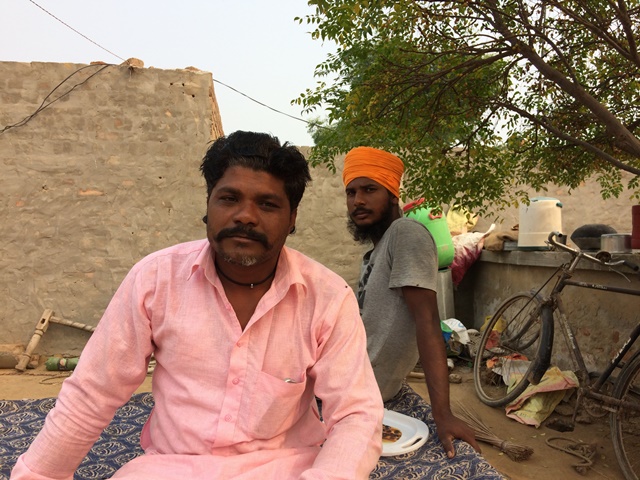
Sukhdev Singhji. Credit: M Rajshekhar
In this part of India, it is the kharif crop – usually a cash crop like basmati or cotton – that introduces variability into farmers’ annual income. The winter crop, usually sold to the government at fixed rates, is more of a safety net. Like Hazara Ram, Sukhdev Singhji, a resident of Balwana village near Abohar, will not make any money on his cotton crop this year. He will make money only if wheat (kanak, in Punjabi) does well: “Kanak bachave to bachave.”
There is another issue here: Given that whitefly go through four stages – egg, nymph, pupa and adult – how did farmers like Ram know the stage of infection and therefore the appropriate medicines to spray?
They went by what agricultural traders or company agents – whose job is to sell pesticides – told them.
The rise of new ‘knowhow’
As Punjab’s extension machinery weakened, other actors stepped into the void – such as companies that sell fertiliser and pesticides. Said the Punjab Agriculture University scientist, “Their agents usually visit villages 15 days before the time of application. If the pesticide doesn’t work, they start working in another village. As it is, they are not even agri-graduates.”
Most of them are very young, said Sukhdev Singhji – “Navey munde. Unhey khud hi nahin pata honda.”
Another entrant into this informational vacuum is the adatiya, the agricultural trader. As an article in the November 7, 2015, issue of the Economic & Political Weekly, titled “Commission Agent System: Significance in Contemporary Agricultural Economy of Punjab”, notes: “They [adatiyas] have become the exploitative alternative for supply of credit, farm and domestic inputs as well as sale of produce. Not only do they provide credit for purchasing essential articles, but also push the farmers to purchase the same from the shops they, or their friends, own.”
One reason for their rise is the worsening economics of agriculture in Punjab.
Take cotton: It is mainly grown in the southern reaches of Punjab, in the Malwa region. On the whole, this is the poorest of the three regions of the state, and the one that sees the most farmer suicides.
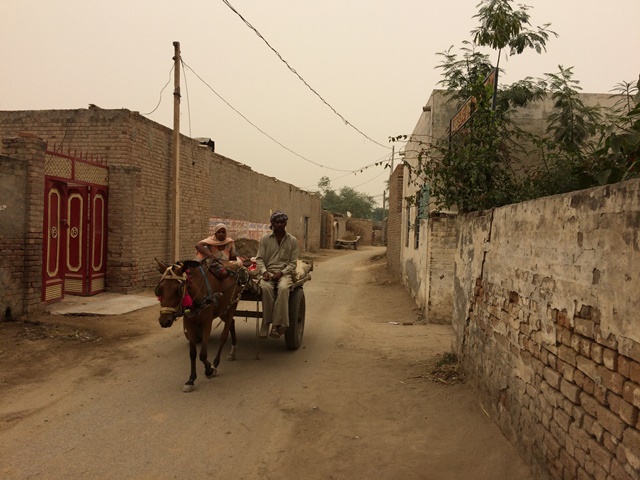
Villages in south-western Punjab’s Malwa region are far poorer than villages elsewhere in Punjab.
Credit: M Rajshekhar
Bt Cotton came here in 2004, in response to the American bollworm attacks that started in 1997. Sukhpal Singh, head of Punjab Agricultural University’s Department of Economics and Sociology, points out that since then, though farmer incomes have risen, their debt has not come down.
There are several reasons for this, Singh said. While Bt Cotton was resistant to bollworm, after about seven or eight years of normalcy, attacks from secondary pests started. At the same time, input costs began rising faster than output prices. “It was partly globalisation. Subsidy on input prices was reduced. Diesel and machinery and seeds got costlier. At the same time, international cotton prices fell.”
This is a story that is playing out all across Punjab. As the cost of agriculture rises and its profitability falls, Punjab’s farmers are being pushed into debt – 89% of all farming households are in debt, according to this EPW paper. They borrow from the adatiyas. When the harvest comes in, they give the crop to the adatiyas who sell it, recover the loan, and give the balance to the farmers.
And so, when whiteflys came, most farmers turned to the traders seeking pesticides. The EPWpaper estimates that 15.01% of pesticides in Punjab (across all crops) are now supplied from the shops of commission agents, and another 80% are procured from the shops owned by people connected to these agents. They, says the paper, issue “a “slip” to farmers for obtaining items from their “owned or connected shops”.

The fungicide that Singhji applied to his cotton fields. Credit: M Rajshekhar
This further compromised farmers’ efforts against whiteflies. There was now the added risk that the traders (who are not farmers) might recommend the wrong pesticide, or one with a greater margin, or that farmers might buy cheaper pesticides to keep their debt low.
Agreed the scientist, “Extension work has collapsed. Paisa nahin hain. Udhaar lena hain. Sasti kaun si hain?”
Singhji, for instance, sprayed a fungicide while trying to take on whitefly.
That won’t work, said Jagdish, the young shop-owner of Balwana, pointing out that farmers sprayed unthinkingly. “Decide kuch nahin kiya, jo mila woh daal diya,” he said. They sprayed whatever they could get.
Other farmers underestimated the whitefly crisis and either sprayed the right medicine too late, or used a milder pesticide than they should have. Matters were further complicated by perennial factors like fake pesticides and batch variations. “I see a farmer’s plot after spraying and if there is no change a day later, I send that batch of spray back,” said Jagdish.
That is the arithmetic of this moment. It’s telling that farmers held off spraying as long as the skies stayed overcast – it shows that farmers’ knowhow is static in a world that is changing fast. The state needs to work on mitigation and adaptation. And for that, it needs to prepare its farmers better.
“Our outreach has to be strengthened,” said Surinder Paul of the Met department. “The information is there. But not all farmers are getting it.”
Failing that, the state will only see the turmoil in its farmlands increase.
29 Sunday Nov 2015
Posted in Current Affairs, Economics, NATIONAL NEWS
Key sectors such as infrastructure, energy, metals, cement, automobiles, pharmaceuticals, and textiles, showed 4 per cent decline in capital expenditure for 2015-16
29 Sunday Nov 2015
Posted in Economics, INTERNATIONAL NEWS
The global economy is settling into a slow-growth rut, steered there by policymakers’ inability or unwillingness to address major impediments at a global level. The question is whether an honest assessment of the impediments to economic performance worldwide will spur policymakers into action.
Source: A Hard Look at a Soft Global Economy by Michael Spence – Project Syndicate
29 Sunday Nov 2015
Posted in Current Affairs, INTERNATIONAL NEWS, USA
Seven years after the Great Recession, 565,000 are living on the streets — as many as a quarter of them children
Source: “The housing crisis is insane”: 6 cities where homelessness is out of control – Salon.com


